Archive for the ‘Fitness’ Category

Pursuing Mastery

Sunday, May 19th, 2013

Some experts believe it takes ten thousand hours of practice to achieve mastery in any particular area. That means if you average ten hours of skating a week (assuming other time commitments to family and a job), achieving world-class skills would take about 20 years. The studies showed it wasn’t innate talent that brought success to the now-famous people, it was lots and lots of hours doing something they were passionate about.

Whether or not you’re aiming to become a world-class skater, it is smart to tailor your hours of practice to achieve improvements sooner rather than later. Below I share tips that have helped my students over the years, and that continue to help me when I’m learning something new (always).

Click to access lessons

Quality Practice Time

  • Skate at every opportunity, three times a week at a minimum; otherwise progress is slow and may even regress.
  • Build your skating skills in the most beneficial sequence, starting with foundational moves. (See right.)
  • Once you learn the proper mechanics of a move, do repetitive drilling to build intuitive muscle memory.
  • If a group of skaters in your area meets regularly to roll around town, join them whenever you can.
  • Skate with more advanced partners to get tips and and try their moves.
  • Skating agility is just as important as efficient, powerful forward motion. Spend plenty of practice time working on drills that focus on balance, turning skills, flexibility and quick responses.
  • Find ways to measure your progress. For example, track distance skated, completion time, and improvements related to your repeated drilling.

Dealing with Fear

Those skaters who look so fearless whizzing down a long, steep slope or doing gravity-defying tricks have encountered and dealt with many, many situations over the years. They look confident and coordinated because years of experience has taught them what tools work and when to use them.

Without that depth of experience, new or dicey situations will make most adult learners tense if not outright terrified. Tenseness and fear create a physical tightness that may result in real danger because it can change our center of gravity and limit our range of motion and flexibility.

Here are some tips to reduce the fearfulness and build more confidence:

  • Spend lots of time practicing your skills (see above)!
  • Learn and obey the Rules of the Road. You’ll see experts disobey, but save those shortcuts for later when you have the skills to deal with the situations they present.
  • Repeatedly replay in your head your favorite “good save” when you did something right to avoid a big crash or mistake.
  • When tenseness is freezing you up, slow and deepen your breathing and tell yourself, “Pretend I’m relaxed!” This may melt some of that tension away and make you safer.
  • One less thing to worry about: keep your gear in great shape by performing regular maintenance.


Understanding Balance

Monday, April 15th, 2013

Based on the article “Plumb Perfect,” written for the May/June 2004 edition of Yoga Journal by Roger Cole, PhD, a certified yoga instructor and research scientist.

I like to encourage skaters at all levels to practice one-foot balance poses to improve agility, coordination and confidence. Such practice also delivers better control over a constantly shifting center of gravity during the motions of skating so we can become more efficient with each stroke. This article discusses how alignment, strength and attention affect your balance practice.

Alignment

Tree poseBalance is the result of aligning our bodies with the earth’s gravitational pull. With both feet firmly planted on the floor, you may be unaware of the fine adjustments going on within your feet, spine and legs to keep yourself upright. You mastered this first balancing act in early childhood even before learning to walk.

Imagine you are standing erect with a lead-weighted fishing line dangling from the ceiling right in front of your nose. When you shift from standing on both feet to a one-footed balance pose such as Yoga’s Tree Pose, the bulk of your body moves slightly to one side and the plumb line will no longer line up with your nose. On raising your knee, you automatically shifted and re-centered your weight to compensate for the new asymmetrical position in order to stay balanced upright.

Strength

One-footed balancing requires strength to compensate for the extra work that prevents you from toppling. In order to stabilize your alignment with gravity, you naturally engage the muscles located at the outside of the hip joints (called the gluteus medius and gluteus minimus). Muscles in your support leg’s shin, outer calf and foot are also working hard.

Warrior 3The great news is that with practice, the amount of muscular involvement diminishes. “The better you get at balances, the less muscular effort you need to maintain them,” says Dr. Roger Cole, PhD, certified yoga instructor and research scientist. “This is because you become more skilled at using your bone structure to support your weight, rather than wasting muscle energy to do so. You also waver less, so you need to make fewer and smaller muscular corrections.”

Even if you do your balances close to a wall for support, each attempt to hold a difficult one-foot balance makes you that much stronger and closer to attaining it.

Attention

Dan on rocker boardSensors in all parts of our bodies are constantly sending signals to the brain. Our eyes help us interpret which direction is up, and the mechanisms in our inner ear dictate the sense of balance. Nerve endings in our limbs and in the bottoms of our feet indicate current body position.

We make adjustments in response to all of these signals to maintain balance. So whether you happen to be standing quietly, balancing on a wobble board, or skating hard and fast, your nervous system is constantly monitoring your position, determining the necessary positional corrections, and sending messages to all the involved muscles to contract or relax.

One way Yoga improves the mind-body connection is through the focused concentration that is required to achieve balance in the more challenging poses. Each time you try one of these, you also get a little stronger in the muscles that shape the pose and make balance possible. And finally, after you master a one-footed pose, the resulting improved agility blesses all of your physical activities—skating and non-skating—with more coordination and confidence.

Free and Easy High, Get Yours Today

Wednesday, February 13th, 2013

Me: “You know how I react under the influence of endorphins, right?”

Him: “Yeah, phew, every morning after your workout!”

Me: “Yesterday I had another shower epiphany after spin class. I was like ‘Wow, I love how I feel so self righteous! I’m such a wonderful person! I’m all set for a great day! Exercise is so great for a person’s self esteem.”

Him: “Mmm hmm.”

Me: “And then I was sharing this thought with another lady in the locker room (poor thing), saying, ‘Man, if only I could bottle this stuff! It would be so great if I could share my overabundance of feeling good with somebody else who really needs it!’”

Me continuing: “I mean, it would be so great if I could give you a shot of it! I know you’ve always said that to you ‘Exercise is a 4-letter word.’ But maybe you should start taking a daily walk around the block and get some of your own?”

Him: “Hah! Endorphins are just another drug!”

Me: “Yes, you’re right, but it’s a great one!”

But I should have also said to him: “And it’s free and so easy to get!”

Project Status (new road bike)

Thursday, January 31st, 2013

Road bike trainer for stationary cyclingAs long as I’m not riding in the real world, I feel pretty comfortable on my road bike! I don’t even think about wearing elbow pads.

A week ago I borrowed a trainer on which I can mount the rear wheel of my bicycle to get a workout in my garage. I don’t need the exercise so much as I need the muscle memory of bicycling basics. The way I see it, I am getting my body used to the bike fit and posture and I can practice moving my hands without fear of losing control of the steering. Some day I’ll have to pull out my water bottle for a drink or signal a turn. I also get to practice looking over my shoulder in preparation for turning when I’m near traffic.

Very importantly, the trainer is helping me learn how to instinctively shift the gears. Sometimes I get it wrong and start to panic. I have ten options for my right hand and two for my left. Riding on my straight, flat rail trail, I’m getting used to simple shifting up and down where the only variables are wind and stop signs at the intersections (and a major dip by the golf course!).

On the trainer I pedal away at a medium resistance, imagining myself biking in my local real world. As I gaze out the window at the peak of Mt. Diablo, I dream of the day I will be able to confidently circle the block in our own neighborhood. Just out my front door is a pretty steep one-block climb followed by a right turn down a gentle slope. Then I must make two right turns to return home. As I turn right again onto my own street and begin to repeat the steep climb, I need to shift correctly or I’ll stall out and have to get a foot out of the pedal clips to prevent a fall.

While practicing shifting on the trainer, I settled on special names for the left-hand gear shifters to use as memory aids. The little lever that makes pedaling easier on the steeps is now named “Wembly” after the steep street I live on. “Westridge” is the name of the gently descending street after I turn right at the top of the hill — and the larger gear I have to push to avoid scaryslipperyspeedy RPMs. Tomorrow I’ll find out if this works better than the many adjectives I’ve tried using to reflect either my shifting incentives or outcomes.

Stay tuned. I’m still evolving!

Biker with Inline Skating Beginner Empathy

Wednesday, January 16th, 2013

There are slopes I’d feel safer descending on my inline skates than on my fancy new road bike. My fears of falling are greater when biking than skating!

That’s why, every week I am devising new ways to live up to my expectations to become competent enough to get over my beginner fears and enjoy myself. The learning process is constantly reminding me of my own advice to beginning inline skaters: in the past 20 years we identified and drilled away dozens of issues related to posture and fear.

So far, many biking situations put me into a panic and make me want to brake and bail, a state I call “terminal velocity.” I know from experience that I can raise the bar on when this feeling kicks in through hours of focused practice. So that’s my plan, even though it’s been bitterly cold these first few weeks of winter.

This morning I re-read my story “Fear: a Blessing and a Curse.” I can definitely apply anxiety-reducing tips I wrote there to my weekly practice sessions.

  • Limit the variables in the chosen learning environment (parking lot)
  • Practice and repetition builds confidence and maintains the learning momentum (weekly biking sessions when possible, and riding stationary on a trainer so can build muscle memory for future activities on the road, like grabbing my water bottle, looking over my shoulder and doing a turn signal)
  • Observe how the bike responds to my movements, how others move on and handle their bikes, how left turns are different than right turns
  • Play around, don’t always drill: get quality rolling time under my belt
  • Accept that fear is healthy and part of who I am (but don’t let it get irrational)

After my half-hour rail-trail ride last Friday, I practiced large figure 8 turns around the tree planters separating the lobes of parking spaces. This Friday, I am going to try guiding the bike between ever-narrowing chalk lines and then pairs of cones to build steering skills and tolerance for tight squeezes.

During spin class these days, I am trying to focus on strengthening my core, spinning with my legs, keeping the weight off my hands and building applicable muscle memory, such as looking behind me over my shoulder.

Now I’m reading a 2001 book by Greg LeMonde (having lost Lance as my hero). Competent cyclists likely don’t remember going through all of this to get as relaxed as they are today. Those who learned young enough and never quit never had to think twice.

But this is the Liz that is.

Rough Day for a Beginner Road Biker

Sunday, December 30th, 2012

When I first started inline skating, I was uncoordinated and erratic on those eight little wheels for a long time. But I was motivated enough to be patient. I remember it took about 20 hours of skating 2-3 times a week before I felt like I didn’t look like a geek, but only as long as I was just moving forward and making wide turns. Learning to stop? That was another 9 months later.

So this bike thing? I’m a lot like a novice inline skater who decided to start out on speed skates instead of entry-level recreational skates.

No hybrid starter bike for me!

Now that I’ve got my new high-end road bike (at my request, mind you), I am hoping 20 hours will be enough! I definitely lack coordination and confidence. It doesn’t help that I’m using clipless bindings, which actually means I am attached to the pedals. That’s not easy to get used to, especially when you forget you’re locked on when rolling up to a stop sign. At least the nice bike shop man put them on the easiest release setting for me.

image

Ouch!

On Sunday I was practicing riding around my neighborhood. I felt pretty good when I survived my stop sign pedal mishap unscathed, though I had to drop the bike and leap away.

We have a nice loop featuring a short steep hill, four corners and a long, gradual descent. It’s a piece of cake on my inline skates in either direction. What got me in trouble was when I left the loop and thought I was ready to stick out my arm to make a turn signal. Wham, bam!! My crash involved many body parts! Now I need a new helmet — but I think my hip and limbs will heal just fine.

Screen capture of facebook comments

My Facebook friends are so helpful! Andrea and Michael are talking about rollerblading, by the way.

My Facebook pals gave me some pretty funny feedback when I posted the above photo. Meanwhile, I’m a third of the way  through Every Woman’s Guide to Cycling.

Of course reading is not going to give me the skills and confidence I’ll get from 20 hours of riding.

No more turn signals for the near future though!

My New Racing Bike

Friday, December 28th, 2012

The gift I received on my 61st Christmas was no surprise.

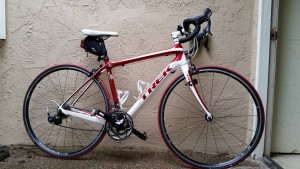
Trek Domane 4.5W bike

Trek Domane 4.5 (ladies) under my Christmas tree

Indeed, I’d agonized over the decision to add road biking to my already long list of recreational interests. But after weeks of weighing the pros and cons, I decided that once I get used to biking in the real world (as opposed to in Spin classes), the fitness animal Liz will obliterate the timid analytical Liz.

However, I am humoring the analytical Liz. Along with the bike, I also requested books geared toward beginning road cyclists. My brother Don came through with two gems and a clunker whose book title is pretty darned close to my own book about skating: “A Beginner’s Guide to Biking.”  Thanks to holiday vacation time to read about and obsess over my new sport, I can strongly recommend both of these:

Since I’m already physically in shape thanks to Spinning, my initial goals are to learn the bike parts names and get used to speed, fast cornering and instinctively getting my foot out of the clipless bindings when stopping.

Knowing me, there will be endorphin-triggered revelations I’ll want to share in this blog. Building skills one step at a time helped me learn to ski the black diamond runs. Articulating what I learned when I took up inline skating resulted in a book. I’m pretty sure my perspectives on becoming a road biker will not be book-worthy, but they might be entertaining, so stay tuned!

And by the way, I am still a skater, though not rolling as frequently as I once was. I am passionate about promoting safer braking technologies and I continue to sell Get Rolling the Beginner’s Guide to Inline Skating all over the world.


Why Thai Chi

Sunday, October 21st, 2012

The martial art of Tai Chi offers many well-documented benefits. Now that I’ve been practicing the Guang P’ing form for a year, I can point out those I find specific to inline skaters:

  • Balance – slow and constant motion, many one-foot stances
  • Coordination – complex transitions involving every body part
  • Strength – the knees are always bent, loading leg muscles
  • Flexibility – everything from wide lunges to high kicks
  • Mind-body – moving meditation, mindful breathing
Group Tai Chi lesson

Master David Bernhardt is at far right

What attracted me to Tai Chi? Mostly the last bullet above, along with the coincidence that just as I’d begun to recognize Tai Chi would be a timely addition to my active lifestyle, I met Sifu David at my day job.

I reached a milestone age last December. While I am (probably overly) proud of my fitness level, I will admit to some creaky body parts that demand extra TLC.  As for brain fitness, those closest to me suggest my enthusiasm borders on the obsessive. While the ability to get things done can be great (and lucrative), those spinning wheels in my head become habit-forming and make it hard to relax and just be.

Poetry in Motion

With Tai Chi, I find that spending the necessary time to add each new move of the 64 that make up the Guang Ping form of Tai Chi is fun and relaxing, even though I am in constant (slow) motion.

But Master David has taught me that memorizing the choreographed sequence is just the beginning. Opportunities abound to achieve the precise kinetic, timing, and directional requirements of Tai Chi. Someday I hope to attend the Guang Ping Yang Conference and see what it’s like to join a large group of fellow practitioners.

For now, though, I am grateful to be learning each move at my own speed through private lessons and by watching David’s DVD — over and over!  I love that the names of some moves are quite poetic. For example, here are the ones I have been working on in the past month:

  • Golden Cock Stands on One Leg
  • Embrace Tiger, Return to Mountain
  • Part Wild Horse’s Mane
  • Beautiful Maiden Weaves with Shuttle

Health and Longevity

Learning Tai Chi is not a short-term thing, nor is it like other fitness activities where you leave it behind after a session. My goals go beyond the skating and physical benefits: I am in it for the long haul, knowing its value to my ongoing process of aging gracefully.

Regular tai chi practice enhances health by activating the mind, by calming the nervous system, and by keeping the joints flexible, the muscles toned and the internal organs invigorated.”

– Excerpted from Chi and Tea, David Bernhardt’s web site

Pretend You’re Relaxed!

Sunday, October 21st, 2012

I’ll be giving a lesson, working closely with a student who is making good progress. I’m beaming with pride, thinking to myself, “She’s almost got it!” But I can’t leave well enough alone: I love to watch what happens after I call out, “Now pretend you’re relaxed!” In an instant and without much thought, her spine and arms soften and she looks like she just added on a year’s worth of skating experience. What just happened? It’s not my powers of suggestion (don’t I wish!).

Invariably when I throw this at them, my students instinctively reshape their bodies into a personal memory of what “relaxed” feels like. We both witness an immediate ease and improvement in the way they’re skating. Without realizing quite how, they quit fighting their skates and become more coordinated, if only for the moment. It may be a temporary effect, but I make sure to point out the change so they’ll get a taste of how skating will feel in their future and get a real understanding of the benefits of letting go rather than holding on.

Meditating in skatesTo me, this represents a dramatic demonstration of the inline mind-body connection. By focusing on a more relaxed and familiar body memory, my students have reduced their physical tension and made it possible for the skates to behave.

Relax and Allow

New skaters start out with jerky movements because they are holding tight to a large number of muscles in the attempt to maintain control. Fear and bodily tension hinder the mobility and balanced postures that will one day bring fluid movement. It takes time and experience (and instruction) to eventually grow the right muscle memories that result in 1) better balance and 2) greater confidence so they are 3) able to relax and 4) skate more efficiently.

Of course, you want to look good on skates as soon as possible, right? Your first priority is to start practicing a wide variety of skating moves to build up your mobility and agility. You also need to know what “relaxed” feels like in your own body, so you can deliberately call it up at will. Sound hard? Visit my Mind-Body Connection section of GetRolling.com for lessons that will help you learn to breathe properly, reduce stress through meditation, and gain kinetic and emotional self-awareness that can lead to optimal fitness and performance.

Quality time on skates will eventually lead to letting the skates do their job rather than trying to make them perform.

Grace and Speed

Sustained aerobic-level skating typically results in a natural high from endorphins, a delightful chemical manufactured in the human body. Besides enjoying the optimism and happiness it brings, if you also focus on harnessing the creativity of this mental state, you stand to gain significant technique breakthroughs.

Pay attention to the rhythm of your movements as you repeatedly stride and glide. Visualize a center line in the path ahead and find new ways to smooth out anything that wastes energy or deflects you from a straight-ahead flow along that line. Play around with your favorite stride improvement drills. Breathe.

As you begin to feel tired, employ your creative endorphin high to devise ways to “work smarter, not harder.” Check your posture to make sure your weight remains stacked over your heels, the power-generating part of your skates.

Pretend you’re relaxed! Let your skates do their job.

The Endorphins, Yes

Thursday, October 4th, 2012

I am so intensely affected by the exercise high that I have to avoid talking to people afterwards until my unleashed animal side returns to napping in its cage–usually about an hour. What happens to you? I’d love to see your comments below.

Energy. (Life) “Ok, it’s time to take off my sweatshirt.”

Endurance. (Action) “Focus! If I can make it up Kilimanjaro, I can get through this 4-minute spin class hill.”

Escape. (Distraction) “The Zanzibar beach hotel, now that was a romantic spot!”

Existence. (Survival) “All I have to do is get through the next 20 minutes and I’m home free!” (pant, pant)

Emergence. (Solutions) “Wow! I have the answer! I am dying to tackle this right now!”

Excitement. (Plans) “I must order a Carl Sandburg book the moment I get out of this spin class!!

Enthusiasm. (I love everybody! I can’t wait to get to work today!)


A hilarious post from Stephanie White, another spinner here.