Archive for the ‘Liz’s Journal’ Category

Switching to Two Wheels

Sunday, May 19th, 2013

After 20 years as a formal publication and the voice of Get Rolling, the quarterly Get Rolling Orbit Inline Skating Newsletter is going into quiet retirement.

What does this mean?

  • There will be no more mailing list and no more email announcements.
  • People who follow Get Rolling with Liz Miller on Facebook or Sk8teacher on Twitter will continue to have access to my posts there.
  • Orbit archives prior to May 2010 (when I started using WordPress) will still be available on GetRolling.com.
  • With social media delivering my communications whenever I have something to say or share, the GetRolling home page will change less frequently, at least for now.

What’s next?

  • Last year I retired from active teaching but I still continue to support the Skate Instructors Association (SkateIA)
  • I will continue assessing and supporting inline brake technologies that I believe deserve a place in the market.
  • I will continue to add blog posts whenever I have something to say, but likely my articles will be more about fitness, biking and adventurous vacations.
  • Similar to when I started skating in 1982, I am now pursuing mastery on my new road bike. I have a performance bike and try to maintain a “performance body,” but I am years behind in bike handling experience and confidence, with 2/3 of my expected lifespan already gone. My keys to  road biking success are not so different from when I was learning to skate. Incremental improvements come from:
    • the positive feedback of minor improvements every time I ride
    • the desire to not look like a geek and to keep up with biking buddies
    • many quality hours on the bike and muscle memory drilling (practice, practice, practice!)

I’d love it if you want to continue following the next 20 years of my active lifestyle  through Facebook or Twitter. If not, it’s been spectacular and wonderful having all of you in my life!

45684_511439348903022_1552890913_nLiz Miller
Author of Get Rolling and Advanced Inline Skating
Beginner help: www.GetRolling.com
California Trails: www.CASkating.com


Project Status (new road bike)

Thursday, January 31st, 2013

Road bike trainer for stationary cyclingAs long as I’m not riding in the real world, I feel pretty comfortable on my road bike! I don’t even think about wearing elbow pads.

A week ago I borrowed a trainer on which I can mount the rear wheel of my bicycle to get a workout in my garage. I don’t need the exercise so much as I need the muscle memory of bicycling basics. The way I see it, I am getting my body used to the bike fit and posture and I can practice moving my hands without fear of losing control of the steering. Some day I’ll have to pull out my water bottle for a drink or signal a turn. I also get to practice looking over my shoulder in preparation for turning when I’m near traffic.

Very importantly, the trainer is helping me learn how to instinctively shift the gears. Sometimes I get it wrong and start to panic. I have ten options for my right hand and two for my left. Riding on my straight, flat rail trail, I’m getting used to simple shifting up and down where the only variables are wind and stop signs at the intersections (and a major dip by the golf course!).

On the trainer I pedal away at a medium resistance, imagining myself biking in my local real world. As I gaze out the window at the peak of Mt. Diablo, I dream of the day I will be able to confidently circle the block in our own neighborhood. Just out my front door is a pretty steep one-block climb followed by a right turn down a gentle slope. Then I must make two right turns to return home. As I turn right again onto my own street and begin to repeat the steep climb, I need to shift correctly or I’ll stall out and have to get a foot out of the pedal clips to prevent a fall.

While practicing shifting on the trainer, I settled on special names for the left-hand gear shifters to use as memory aids. The little lever that makes pedaling easier on the steeps is now named “Wembly” after the steep street I live on. “Westridge” is the name of the gently descending street after I turn right at the top of the hill — and the larger gear I have to push to avoid scaryslipperyspeedy RPMs. Tomorrow I’ll find out if this works better than the many adjectives I’ve tried using to reflect either my shifting incentives or outcomes.

Stay tuned. I’m still evolving!

Biker with Inline Skating Beginner Empathy

Wednesday, January 16th, 2013

There are slopes I’d feel safer descending on my inline skates than on my fancy new road bike. My fears of falling are greater when biking than skating!

That’s why, every week I am devising new ways to live up to my expectations to become competent enough to get over my beginner fears and enjoy myself. The learning process is constantly reminding me of my own advice to beginning inline skaters: in the past 20 years we identified and drilled away dozens of issues related to posture and fear.

So far, many biking situations put me into a panic and make me want to brake and bail, a state I call “terminal velocity.” I know from experience that I can raise the bar on when this feeling kicks in through hours of focused practice. So that’s my plan, even though it’s been bitterly cold these first few weeks of winter.

This morning I re-read my story “Fear: a Blessing and a Curse.” I can definitely apply anxiety-reducing tips I wrote there to my weekly practice sessions.

  • Limit the variables in the chosen learning environment (parking lot)
  • Practice and repetition builds confidence and maintains the learning momentum (weekly biking sessions when possible, and riding stationary on a trainer so can build muscle memory for future activities on the road, like grabbing my water bottle, looking over my shoulder and doing a turn signal)
  • Observe how the bike responds to my movements, how others move on and handle their bikes, how left turns are different than right turns
  • Play around, don’t always drill: get quality rolling time under my belt
  • Accept that fear is healthy and part of who I am (but don’t let it get irrational)

After my half-hour rail-trail ride last Friday, I practiced large figure 8 turns around the tree planters separating the lobes of parking spaces. This Friday, I am going to try guiding the bike between ever-narrowing chalk lines and then pairs of cones to build steering skills and tolerance for tight squeezes.

During spin class these days, I am trying to focus on strengthening my core, spinning with my legs, keeping the weight off my hands and building applicable muscle memory, such as looking behind me over my shoulder.

Now I’m reading a 2001 book by Greg LeMonde (having lost Lance as my hero). Competent cyclists likely don’t remember going through all of this to get as relaxed as they are today. Those who learned young enough and never quit never had to think twice.

But this is the Liz that is.

Rough Day for a Beginner Road Biker

Sunday, December 30th, 2012

When I first started inline skating, I was uncoordinated and erratic on those eight little wheels for a long time. But I was motivated enough to be patient. I remember it took about 20 hours of skating 2-3 times a week before I felt like I didn’t look like a geek, but only as long as I was just moving forward and making wide turns. Learning to stop? That was another 9 months later.

So this bike thing? I’m a lot like a novice inline skater who decided to start out on speed skates instead of entry-level recreational skates.

No hybrid starter bike for me!

Now that I’ve got my new high-end road bike (at my request, mind you), I am hoping 20 hours will be enough! I definitely lack coordination and confidence. It doesn’t help that I’m using clipless bindings, which actually means I am attached to the pedals. That’s not easy to get used to, especially when you forget you’re locked on when rolling up to a stop sign. At least the nice bike shop man put them on the easiest release setting for me.

image

Ouch!

On Sunday I was practicing riding around my neighborhood. I felt pretty good when I survived my stop sign pedal mishap unscathed, though I had to drop the bike and leap away.

We have a nice loop featuring a short steep hill, four corners and a long, gradual descent. It’s a piece of cake on my inline skates in either direction. What got me in trouble was when I left the loop and thought I was ready to stick out my arm to make a turn signal. Wham, bam!! My crash involved many body parts! Now I need a new helmet — but I think my hip and limbs will heal just fine.

Screen capture of facebook comments

My Facebook friends are so helpful! Andrea and Michael are talking about rollerblading, by the way.

My Facebook pals gave me some pretty funny feedback when I posted the above photo. Meanwhile, I’m a third of the way  through Every Woman’s Guide to Cycling.

Of course reading is not going to give me the skills and confidence I’ll get from 20 hours of riding.

No more turn signals for the near future though!

Why Thai Chi

Sunday, October 21st, 2012

The martial art of Tai Chi offers many well-documented benefits. Now that I’ve been practicing the Guang P’ing form for a year, I can point out those I find specific to inline skaters:

  • Balance – slow and constant motion, many one-foot stances
  • Coordination – complex transitions involving every body part
  • Strength – the knees are always bent, loading leg muscles
  • Flexibility – everything from wide lunges to high kicks
  • Mind-body – moving meditation, mindful breathing
Group Tai Chi lesson

Master David Bernhardt is at far right

What attracted me to Tai Chi? Mostly the last bullet above, along with the coincidence that just as I’d begun to recognize Tai Chi would be a timely addition to my active lifestyle, I met Sifu David at my day job.

I reached a milestone age last December. While I am (probably overly) proud of my fitness level, I will admit to some creaky body parts that demand extra TLC.  As for brain fitness, those closest to me suggest my enthusiasm borders on the obsessive. While the ability to get things done can be great (and lucrative), those spinning wheels in my head become habit-forming and make it hard to relax and just be.

Poetry in Motion

With Tai Chi, I find that spending the necessary time to add each new move of the 64 that make up the Guang Ping form of Tai Chi is fun and relaxing, even though I am in constant (slow) motion.

But Master David has taught me that memorizing the choreographed sequence is just the beginning. Opportunities abound to achieve the precise kinetic, timing, and directional requirements of Tai Chi. Someday I hope to attend the Guang Ping Yang Conference and see what it’s like to join a large group of fellow practitioners.

For now, though, I am grateful to be learning each move at my own speed through private lessons and by watching David’s DVD — over and over!  I love that the names of some moves are quite poetic. For example, here are the ones I have been working on in the past month:

  • Golden Cock Stands on One Leg
  • Embrace Tiger, Return to Mountain
  • Part Wild Horse’s Mane
  • Beautiful Maiden Weaves with Shuttle

Health and Longevity

Learning Tai Chi is not a short-term thing, nor is it like other fitness activities where you leave it behind after a session. My goals go beyond the skating and physical benefits: I am in it for the long haul, knowing its value to my ongoing process of aging gracefully.

Regular tai chi practice enhances health by activating the mind, by calming the nervous system, and by keeping the joints flexible, the muscles toned and the internal organs invigorated.”

– Excerpted from Chi and Tea, David Bernhardt’s web site

The Endorphins, Yes

Thursday, October 4th, 2012

I am so intensely affected by the exercise high that I have to avoid talking to people afterwards until my unleashed animal side returns to napping in its cage–usually about an hour. What happens to you? I’d love to see your comments below.

Energy. (Life) “Ok, it’s time to take off my sweatshirt.”

Endurance. (Action) “Focus! If I can make it up Kilimanjaro, I can get through this 4-minute spin class hill.”

Escape. (Distraction) “The Zanzibar beach hotel, now that was a romantic spot!”

Existence. (Survival) “All I have to do is get through the next 20 minutes and I’m home free!” (pant, pant)

Emergence. (Solutions) “Wow! I have the answer! I am dying to tackle this right now!”

Excitement. (Plans) “I must order a Carl Sandburg book the moment I get out of this spin class!!

Enthusiasm. (I love everybody! I can’t wait to get to work today!)


A hilarious post from Stephanie White, another spinner here.

Story of a Self-Published Author

Sunday, September 23rd, 2012

It’s been awhile since I produced the third edition of Get Rolling, the Beginner’s Guide to Inline Skating, but I have checked the links below and they are still good guides for anybody who is interested in writing and  publishing their own book.

I am not the best person to ask about finding a publisher because, except for one case, my publishers found me or I self-published. The one time I got a publisher to take over my book was when I approached a travel company with my first edition of Get Rolling, and they signed me up to put together a skate trails tour book and I inserted my how-to section into the front pages. Out of print now, my work has since been transformed to an online database of skate tours, www.CASkating.com.

Self publishing

I published my only book currently still in print, Get Rolling, the Beginner’s Guide to In-Line Skating, now in its 4th printing. I call my publishing company Get Rolling Books. To credibly and effectively sell paperback books in the US, you must deal with the Library of Congress, the publishers of “Books in Print” and a book distributor that serves libraries. Here is where to find out how to do everything to get your book produced and sold: http://parapub.com/sites/para/  the web site of Dan Poynter, the self publisher’s guru.

I read The Self-Publishing Manual in 1992, decided I had what it takes to be successful, and then followed all of Dan’s advice. When I got the copyright returned to me and self published my third edition of Get Rolling in 2004, I discovered much of that process has gotten easier thanks to the internet and digital printing.

Production

For production, I was referred to a northern California printing company named DeHart’s for the printing. http://www.deharts.com/ . I have been very happy working with them, and they are close enough that I can drive there to pick up my latest 1,000 copies.

I sent  them two giant PDF files after getting a quote on an initial run of 500 books. Since that first printing I have ordered 1000 books two more times because printing is cheaper in larger quantities. When the books are ready, I save money by going to pick them up in my SUV and then I store them in my garage. I pay about $5 per copy, and my selling price is $14.95.

To sell my book, I have set up a consignment account with Amazon.com under their Amazon Advantage program. They send me a book order every Sunday. Their orders are initially small (like 1 book) but as people start buying the book their orders go up in response. I pay shipping and they get 55% discount off my selling price.  Here’s a link to Amazon Advantage:
http://advantage.amazon.com/gp/vendor/public/join

Self publishing a new book is tedious and time-consuming work, but once the production and launch are done, you can coast on that effort for years. If you have a popular web site and can convince people to purchase directly from you (PayPal payments), you can charge the full cover price and customers will pay your shipping.

Working with established publishers

A subsidiary of McGraw Hill discovered my self-published first edition of Get Rolling and asked to publish it themselves. I provided updated text and photos. With 5,000 sold the first year, they ordered another 5,000 before returning the copyright to me. Before that happened, I also wrote a second book for them.

I enjoyed working with publishers and their editors and letting them do the hard work. My books have never been block busters so none of us made much money. The biggest advance I got was $2,000 on contract signing with a second $2,000 on delivery. The worst-selling of my books — one they asked me to write just before inline skating began to lose its popularity — never did return their full royalty investment.

Lifestyle benefits of being an author

That said, I have enjoyed many indirect benefits from my book writing and publishing efforts. I am respected all over the world by skating beginners because I won’t let Get Rolling die. I work as a skate tour guide and Camp Rollerblade Instructor for an adventure travel company (they found me through my CA Skating trail guide) that results in considerable discounts when I want to be a customer — like climbing Mt. Kilimanjaro, hiking the Great Wall in China, and most recently, guiding tourists to Machu Picchu — all because I dared to write and publish that first book in 1992.

Paying attention to trail hazards

Sunday, June 10th, 2012

It was a beautiful spring day for a roll on the trail.

My ski season doesn’t end until after Memorial Day, but with the arrival of spring, the early Daylight Saving time and our first hot spell, I chose a day in late April for my first skating workout of the year. I literally dusted off my skates (we’ve just survived a complete kitchen remodel), and hit the streets, relishing the faint vibrations of urethane on smooth pavement.

It was after 10 am when I entered the Iron Horse Trail, already crowded with cyclists, walkers, joggers, and folks pushing baby strollers or walking their dogs. I gave a friendly wave as I passed a silver-haired gent on inlines, fully geared, as I was.

Awareness pays off

I had an unusually strong focus on safety that day. With the participants at an upcoming Camp Rollerblade on my mind along with my recent writing assignments for the safety team at the company where I work, I felt compelled to track the safety hazards I encountered during my 45 minutes on the trail:

  • twigs and other bumpy surface debris remaining from the winter
  • dogs darting about both on and off their leashes
  • clots of people and the frequent need to pass them from behind
  • trail users not leaving any room to pass, not paying attention
  • converging opposing traffic competing for passing room
  • reduced visibility and a blanket of moist leaves in the shade
  • bumpy transitions from street to trail at intersections
  • gaping cracks just the right width to snag my wheels
Photo of patched crack in asphalt on trail
Step on a crack and break your own back!

“Hm,” I mused. “Flat and car-free as it is, this is really not a great trail for beginners today.”

However, because I know how to avoid or handle the worst of these common trail hazards, I relished stride after stride in my Spark Pro skates after such a long time away from them.

A canine altercation

A few miles out, I approached a pair of ladies at a trail-side bench with two large, friendly-looking dogs on leashes. Suddenly a little pooch darted out from behind them and sprinted toward me, barking furiously. I braked to a screeching halt as one woman leaped up, grabbed him, and delivered a spanking, yelling, “Bad dog, bad dog!”

Meanwhile, the other woman released her shaggy charges in the excitement. They came trotting over to greet me, wrapping the leash that connected them around my legs. “Well, now we’ve got another problem,” I grinned. I didn’t feel a need to chastise the lady who was beating the smaller dog. She was obviously mortified over his antics.

Extricating myself from the leash, I continued skating up the trail. After encountering an entire classroom of middle schoolers a bit further ahead, I finally decided my workout was half finished and did an about face. Heading back, I managed to slip unseen past the “bad dog,”who had just wriggled out of his leash and again dashed away from his handler. I completed my first skating errand of 2012 by stopping in at my mobile phone store and then skated back home to have lunch in my beautiful new kitchen.

Off-Skates Fitness

Sunday, July 10th, 2011

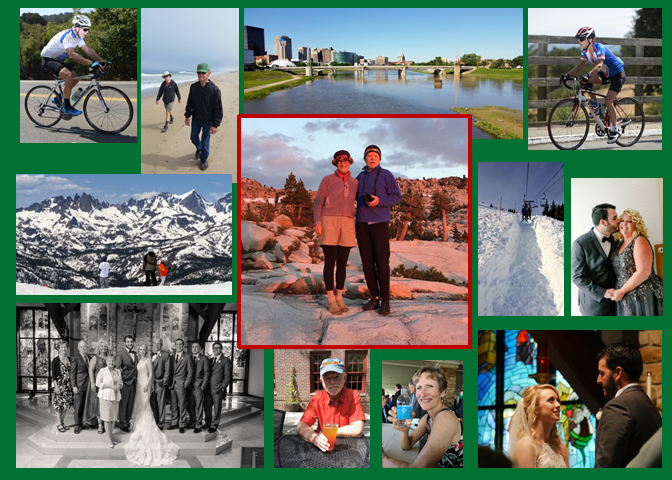
I love taking great care of my body, I love playing and exercising outdoors, and I love exploring the places I visit away from home in a human-powered way. The past six weeks have been busy in exactly this way for me and Dan. To summarize, we:

  • Skied three full days (in winter conditions!) at Mammoth Mountain over the Memorial Day holiday
  • Biked 40 miles and walked a few more during a 4-day visit to lovely Victoria BC, Canada
  • Hiked  up and down steep Las Trampas Ridge in our back yard, and skated (me) and biked (Dan) the Iron Horse Trail during the work weeks
  • Backpacked 30+ miles with 30+ pound packs on the Yosemite North Rim trail over the July 4th weekend

A few years back, I created the Get Rolling Off-Skates Fitness web pages after realizing that my active, outdoorsy lifestyle sets a good example for others. This section of my website offers a path to an overall level of fitness that benefits all physical activities, not just inline skating. To accommodate different starting levels, I documented a sample workout week for beginner, intermediate and advanced exercisers.

For skating in particular, fitness is necessary for those just beginning, especially middle-aged or older skaters, because it reduces the chance of injury while improving the chance of success. Flexibility and strength are important to achieving the most powerful inline skating stroke possible.

  • Flexible joints give you increased stroke length, while a regular stretching routine can help prevent joint injuries and reduce muscle soreness.
  • Strong legs allow you to sprint away from a pack or climb a long hill without using up all of your resources.
  • A solid core means better agility and balance.
  • Proper breathing and a quiet mind keep you alert and composed in dicey situations.

These aptitudes do not come from skate training alone: they result from specific and consistently-performed off-skate training activities. Are you ready for a fitness lifestyle? I’m here to help!

From Spin to REAL Biking

Saturday, June 25th, 2011

For the past 30 years, I can count the times I have ridden a bicycle out in the world on one hand. That’s one reason I got so deeply into inline skating. Dan would bike and I would go for a skate.

Within a few weeks of meeting Prince Charming Dan, I mounted my own bike on a stationary stand and never looked back. I knew I’d always be a sissy on the downhills. Dan and I already had a physically competitive relationship, and I could see he was a serious biker. I could not compete in this area and did not want to be an annoying lagger.

But now that Spin classes have built up my tolerance for sitting on a bike and rotating the pedals, I felt safe in saying yes to exploring the area in and around the beautiful Canadian city of Victoria, BC, a 2-hour ferry ride north of Seattle, WA. It would be fun to try out my new-found biking fitness on a moving bike. Further ahead, there will be at least one biking day on our multisport wine Tour in Chile and Argentina later this year and I wanted to get comfortable with shifting and any other issues.

What a scaredy cat I turned out to be!

There were more challenges in bustling Victoria than just learning how to shift the gears. First off, the rental place is smack dab in the middle of the city, with double-lane traffic, no bike lanes, and clueless motorists opening doors or pulling to the curb right in front of us. Trying to follow Dan and Clark as they casually maneuvered through all this was not my idea of a fun first mile on a bike!

And when did they stop making girly bikes? I had trouble getting the pedals rotating while throwing my leg over the saddle, with the bike quite often in the wrong gear for starting out. None of this stuff was second nature to me. Every bit of it was a distraction to be dealt with along with everything else. Oh, how I sympathized with my inline skating students as I felt the urge to call out “Watch out, I can’t stop!” to pedestrians or other cyclists on the street or bike path whose actions forced me to react in some way.

And the hills. Going up was OK, especially after I got good enough to shift to lower gears without dislodging the chain (I finally gave up on the gear combo of  1/1). Going down, though,  I kept a death grip on both brakes. I squeezed at the first hint of a downhill. This is what I do on skates too: I start dragging my heel brake just to reassure myself I am ready to apply full braking force the moment I feel the need.

We did some street biking on Friday and I felt proud and relieved at having survived about 20 miles of very scenic touring around the shoreline of the island, on city streets, down a couple of miles of gravel trail, and finally on a dedicated bike path. I was slow on the downhills but pedaled madly to catch up with my boys on the uphills. Legs and lungs felt good, and no butt or back pain!

On Saturday we biked another 20 miles, this time on a portion of a gorgeous trail I would recommend to my skating friends in an instant. The only glitch I had that day was the thunk, thunk, thunk that made me think I had a flat tire. It turned out I’d forgotten to pull up the kickstand.

On Sunday morning I woke up with a pretty bad backache that plagued me as I lugged my rolling bag with the disintegrating wheels back to the ferry, the light rail and finally the airport check-in. I learned several days later that I was in the throes of a systemic infection at that point, so I do not know if there was any muscle soreness from biking or if it was all kidney pain.

Now that I am feeling wonderful again, I can look back at my weekend of bike touring in Victoria BC with pleasure, and look forward to future bike adventures with less trepidation.