the Get Rolling Orbit Biking ~ Fitness ~ Adventures ~ Inline Skating

December 30, 2012

Rough Day for a Beginner Road Biker

Filed under: Biking — Tags: , — Liz Miller @ 5:50 pm

When I first started inline skating, I was uncoordinated and erratic on those eight little wheels for a long time. But I was motivated enough to be patient. I remember it took about 20 hours of skating 2-3 times a week before I felt like I didn’t look like a geek, but only as long as I was just moving forward and making wide turns. Learning to stop? That was another 9 months later.

So this bike thing? I’m a lot like a novice inline skater who decided to start out on speed skates instead of entry-level recreational skates.

No hybrid starter bike for me!

Now that I’ve got my new high-end road bike (at my request, mind you), I am hoping 20 hours will be enough! I definitely lack coordination and confidence. It doesn’t help that I’m using clipless bindings, which actually means I am attached to the pedals. That’s not easy to get used to, especially when you forget you’re locked on when rolling up to a stop sign. At least the nice bike shop man put them on the easiest release setting for me.

image

Ouch!

On Sunday I was practicing riding around my neighborhood. I felt pretty good when I survived my stop sign pedal mishap unscathed, though I had to drop the bike and leap away.

We have a nice loop featuring a short steep hill, four corners and a long, gradual descent. It’s a piece of cake on my inline skates in either direction. What got me in trouble was when I left the loop and thought I was ready to stick out my arm to make a turn signal. Wham, bam!! My crash involved many body parts! Now I need a new helmet — but I think my hip and limbs will heal just fine.

Screen capture of facebook comments

My Facebook friends are so helpful! Andrea and Michael are talking about rollerblading, by the way.

My Facebook pals gave me some pretty funny feedback when I posted the above photo. Meanwhile, I’m a third of the way  through Every Woman’s Guide to Cycling.

Of course reading is not going to give me the skills and confidence I’ll get from 20 hours of riding.

No more turn signals for the near future though!

December 28, 2012

My New Racing Bike

Filed under: Biking — Liz Miller @ 4:03 pm

The gift I received on my 61st Christmas was no surprise.

Trek Domane 4.5W bike

Trek Domane 4.5 (ladies) under my Christmas tree

Indeed, I’d agonized over the decision to add road biking to my already long list of recreational interests. But after weeks of weighing the pros and cons, I decided that once I get used to biking in the real world (as opposed to in Spin classes), the fitness animal Liz will obliterate the timid analytical Liz.

However, I am humoring the analytical Liz. Along with the bike, I also requested books geared toward beginning road cyclists. My brother Don came through with two gems and a clunker whose book title is pretty darned close to my own book about skating: “A Beginner’s Guide to Biking.”  Thanks to holiday vacation time to read about and obsess over my new sport, I can strongly recommend both of these:

Since I’m already physically in shape thanks to Spinning, my initial goals are to learn the bike parts names and get used to speed, fast cornering and instinctively getting my foot out of the clipless bindings when stopping.

Knowing me, there will be endorphin-triggered revelations I’ll want to share in this blog. Building skills one step at a time helped me learn to ski the black diamond runs. Articulating what I learned when I took up inline skating resulted in a book. I’m pretty sure my perspectives on becoming a road biker will not be book-worthy, but they might be entertaining, so stay tuned!

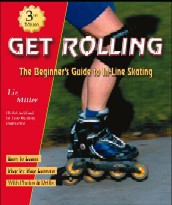
And by the way, I am still a skater, though not rolling as frequently as I once was. I am passionate about promoting safer braking technologies and I continue to sell Get Rolling the Beginner’s Guide to Inline Skating all over the world.


October 21, 2012

Why Thai Chi

Filed under: Biking,Fitness,Liz's Journal,Skating — Liz Miller @ 4:42 pm

The martial art of Tai Chi offers many well-documented benefits. Now that I’ve been practicing the Guang P’ing form for a year, I can point out those I find specific to inline skaters:

  • Balance – slow and constant motion, many one-foot stances
  • Coordination – complex transitions involving every body part
  • Strength – the knees are always bent, loading leg muscles
  • Flexibility – everything from wide lunges to high kicks
  • Mind-body – moving meditation, mindful breathing
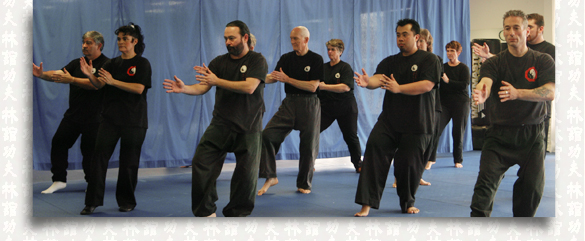
Group Tai Chi lesson

Master David Bernhardt is at far right

What attracted me to Tai Chi? Mostly the last bullet above, along with the coincidence that just as I’d begun to recognize Tai Chi would be a timely addition to my active lifestyle, I met Sifu David at my day job.

I reached a milestone age last December. While I am (probably overly) proud of my fitness level, I will admit to some creaky body parts that demand extra TLC.  As for brain fitness, those closest to me suggest my enthusiasm borders on the obsessive. While the ability to get things done can be great (and lucrative), those spinning wheels in my head become habit-forming and make it hard to relax and just be.

Poetry in Motion

With Tai Chi, I find that spending the necessary time to add each new move of the 64 that make up the Guang Ping form of Tai Chi is fun and relaxing, even though I am in constant (slow) motion.

But Master David has taught me that memorizing the choreographed sequence is just the beginning. Opportunities abound to achieve the precise kinetic, timing, and directional requirements of Tai Chi. Someday I hope to attend the Guang Ping Yang Conference and see what it’s like to join a large group of fellow practitioners.

For now, though, I am grateful to be learning each move at my own speed through private lessons and by watching David’s DVD — over and over!  I love that the names of some moves are quite poetic. For example, here are the ones I have been working on in the past month:

  • Golden Cock Stands on One Leg
  • Embrace Tiger, Return to Mountain
  • Part Wild Horse’s Mane
  • Beautiful Maiden Weaves with Shuttle

Health and Longevity

Learning Tai Chi is not a short-term thing, nor is it like other fitness activities where you leave it behind after a session. My goals go beyond the skating and physical benefits: I am in it for the long haul, knowing its value to my ongoing process of aging gracefully.

“Regular tai chi practice enhances health by activating the mind, by calming the nervous system, and by keeping the joints flexible, the muscles toned and the internal organs invigorated.”

— Excerpted from Chi and Tea, David Bernhardt’s web site

Pretend You’re Relaxed!

Filed under: Fitness,Skating — Liz Miller @ 2:46 pm

I’ll be giving a lesson, working closely with a student who is making good progress. I’m beaming with pride, thinking to myself, “She’s almost got it!” But I can’t leave well enough alone: I love to watch what happens after I call out, “Now pretend you’re relaxed!” In an instant and without much thought, her spine and arms soften and she looks like she just added on a year’s worth of skating experience. What just happened? It’s not my powers of suggestion (don’t I wish!).

Invariably when I throw this at them, my students instinctively reshape their bodies into a personal memory of what “relaxed” feels like. We both witness an immediate ease and improvement in the way they’re skating. Without realizing quite how, they quit fighting their skates and become more coordinated, if only for the moment. It may be a temporary effect, but I make sure to point out the change so they’ll get a taste of how skating will feel in their future and get a real understanding of the benefits of letting go rather than holding on.

Meditating in skatesTo me, this represents a dramatic demonstration of the inline mind-body connection. By focusing on a more relaxed and familiar body memory, my students have reduced their physical tension and made it possible for the skates to behave.

Relax and Allow

New skaters start out with jerky movements because they are holding tight to a large number of muscles in the attempt to maintain control. Fear and bodily tension hinder the mobility and balanced postures that will one day bring fluid movement. It takes time and experience (and instruction) to eventually grow the right muscle memories that result in 1) better balance and 2) greater confidence so they are 3) able to relax and 4) skate more efficiently.

Of course, you want to look good on skates as soon as possible, right? Your first priority is to start practicing a wide variety of skating moves to build up your mobility and agility. You also need to know what “relaxed” feels like in your own body, so you can deliberately call it up at will. Sound hard? Visit my Mind-Body Connection section of GetRolling.com for lessons that will help you learn to breathe properly, reduce stress through meditation, and gain kinetic and emotional self-awareness that can lead to optimal fitness and performance.

Quality time on skates will eventually lead to letting the skates do their job rather than trying to make them perform.

Grace and Speed

Sustained aerobic-level skating typically results in a natural high from endorphins, a delightful chemical manufactured in the human body. Besides enjoying the optimism and happiness it brings, if you also focus on harnessing the creativity of this mental state, you stand to gain significant technique breakthroughs.

Pay attention to the rhythm of your movements as you repeatedly stride and glide. Visualize a center line in the path ahead and find new ways to smooth out anything that wastes energy or deflects you from a straight-ahead flow along that line. Play around with your favorite stride improvement drills. Breathe.

As you begin to feel tired, employ your creative endorphin high to devise ways to “work smarter, not harder.” Check your posture to make sure your weight remains stacked over your heels, the power-generating part of your skates.

Pretend you’re relaxed! Let your skates do their job.

October 4, 2012

The Endorphins, Yes

Filed under: Fitness,Liz's Journal — Tags: , , — Liz Miller @ 10:12 pm

I am so intensely affected by the exercise high that I have to avoid talking to people afterwards until my unleashed animal side returns to napping in its cage–usually about an hour. What happens to you? I’d love to see your comments below.

Energy. (Life) “Ok, it’s time to take off my sweatshirt.”

Endurance. (Action) “Focus! If I can make it up Kilimanjaro, I can get through this 4-minute spin class hill.”

Escape. (Distraction) “The Zanzibar beach hotel, now that was a romantic spot!”

Existence. (Survival) “All I have to do is get through the next 20 minutes and I’m home free!” (pant, pant)

Emergence. (Solutions) “Wow! I have the answer! I am dying to tackle this right now!”

Excitement. (Plans) “I must order a Carl Sandburg book the moment I get out of this spin class!!

Enthusiasm. (I love everybody! I can’t wait to get to work today!)


A hilarious post from Stephanie White, another spinner here.

September 23, 2012

Story of a Self-Published Author

Filed under: Liz's Journal,Skating — Liz Miller @ 3:02 pm

It’s been awhile since I produced the third edition of Get Rolling, the Beginner’s Guide to Inline Skating, but I have checked the links below and they are still good guides for anybody who is interested in writing and  publishing their own book.

I am not the best person to ask about finding a publisher because, except for one case, my publishers found me or I self-published. The one time I got a publisher to take over my book was when I approached a travel company with my first edition of Get Rolling, and they signed me up to put together a skate trails tour book and I inserted my how-to section into the front pages. Out of print now, my work has since been transformed to an online database of skate tours, www.CASkating.com.

Self publishing

I published my only book currently still in print, Get Rolling, the Beginner’s Guide to In-Line Skating, now in its 4th printing. I call my publishing company Get Rolling Books. To credibly and effectively sell paperback books in the US, you must deal with the Library of Congress, the publishers of “Books in Print” and a book distributor that serves libraries. Here is where to find out how to do everything to get your book produced and sold: http://parapub.com/sites/para/  the web site of Dan Poynter, the self publisher’s guru.

I read The Self-Publishing Manual in 1992, decided I had what it takes to be successful, and then followed all of Dan’s advice. When I got the copyright returned to me and self published my third edition of Get Rolling in 2004, I discovered much of that process has gotten easier thanks to the internet and digital printing.

Production

For production, I was referred to a northern California printing company named DeHart’s for the printing. http://www.deharts.com/ . I have been very happy working with them, and they are close enough that I can drive there to pick up my latest 1,000 copies.

I sent  them two giant PDF files after getting a quote on an initial run of 500 books. Since that first printing I have ordered 1000 books two more times because printing is cheaper in larger quantities. When the books are ready, I save money by going to pick them up in my SUV and then I store them in my garage. I pay about $5 per copy, and my selling price is $14.95.

To sell my book, I have set up a consignment account with Amazon.com under their Amazon Advantage program. They send me a book order every Sunday. Their orders are initially small (like 1 book) but as people start buying the book their orders go up in response. I pay shipping and they get 55% discount off my selling price.  Here’s a link to Amazon Advantage:
http://advantage.amazon.com/gp/vendor/public/join

Self publishing a new book is tedious and time-consuming work, but once the production and launch are done, you can coast on that effort for years. If you have a popular web site and can convince people to purchase directly from you (PayPal payments), you can charge the full cover price and customers will pay your shipping.

Working with established publishers

A subsidiary of McGraw Hill discovered my self-published first edition of Get Rolling and asked to publish it themselves. I provided updated text and photos. With 5,000 sold the first year, they ordered another 5,000 before returning the copyright to me. Before that happened, I also wrote a second book for them.

I enjoyed working with publishers and their editors and letting them do the hard work. My books have never been block busters so none of us made much money. The biggest advance I got was $2,000 on contract signing with a second $2,000 on delivery. The worst-selling of my books — one they asked me to write just before inline skating began to lose its popularity — never did return their full royalty investment.

Lifestyle benefits of being an author

That said, I have enjoyed many indirect benefits from my book writing and publishing efforts. I am respected all over the world by skating beginners because I won’t let Get Rolling die. I work as a skate tour guide and Camp Rollerblade Instructor for an adventure travel company (they found me through my CA Skating trail guide) that results in considerable discounts when I want to be a customer — like climbing Mt. Kilimanjaro, hiking the Great Wall in China, and most recently, guiding tourists to Machu Picchu — all because I dared to write and publish that first book in 1992.

Surviving a Nighttime Group Skate

Filed under: Skating — Liz Miller @ 2:41 pm

Paris Friday Night Skate starting line

This may come as a big surprise the first time you join a group skate that rolls through the streets after dark: skating on a dedicated bike path using the basic stride and braking you learned in a parking lot just aren’t enough prep! The perils outside a controlled environment require a few defensive skills to help you safely manage real-world situations.

In a group setting, “sometimes the crowd is very dense and moving very fast,” pointed out Alex, a Get Rolling fan from Israel. “There are often light collisions, e.g., frame-to-frame contact.” He is so right! When unfamiliar terrain, motorists, low or no street lighting, unexpected obstacles, hills, and peer pressure are in the mix, the risk for getting hurt goes way up.

Defensive Skills for the Urban Skater

Before considering your fist roll in the dark with the “big kids,” be sure to get good at the moves that can save your skin. By working your way through the instruction links in the right column below, you will also build an extra layer of protection: confidence in your balance and agility.

Situation Save your skin with…
Sudden red light Heel brake works best, otherwise T-stop or Powerslide
Many skaters, not much space Stride 1 or Swizzles until space opens up
Cracks, rough, cobbles, light-rail tracks High speed Scissors coast
Lagging too far behind the crowd Stride 3. See 10 tips to Increase Your Pushing Power
Speed control on narrow downhills Intermittent braking (“governor“), T drag, “Slowplow”
Speed control on wide downhills Slowing Slaloms — but only if you won’t be cutting off skaters approaching from behind
Impending crash Get low, hands near knees to make a controlled fall on your gear
Curbs and stair steps Angle back skate 45+ degrees to curb. See Taking Curbs at a Roll.
Collision avoidance, too late for brake Hard swerve with a Parallel or tight A-Frame turn. More in Handling Urban Obstacles.

Essential Gear

Priority one in all cases: Wear your helmet and protective gear.

In the dark, you should also take precautions so that motorists can see you and you can see the skating surface ahead. Head lamps, reflective tape or clothing, plastic reflectors, and blinking lights are all good choices. Consider packing along some water, ID and insurance card, light footwear, and cab fare just in case.

Now, go out and meet new skating pals to share the thrilling fun of a critical mass street takeover!

September 9, 2012

Skate (and Eat) With Purpose

Filed under: Fitness,Skating — Liz Miller @ 10:36 am

In-Line Workout Benefits

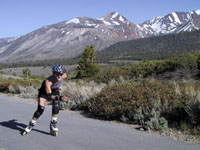
skating Mammoth Main PathFun as it is, skating contributes directly to improving the most sought-after exercise goals: improved aerobic fitness, strength, endurance and body fat reduction. Fast-paced skating has been proved to be just as aerobically beneficial as running; compared to cycling, an equal skating effort results in a better muscular workout for hips, thighs and shins. As long as you apply yourself to purposeful workouts with specific daily goals (as opposed to simply going through the motions), you are setting yourself up to enjoy the maximum possible benefits from fitness skating.

Better aerobic fitness: The benefits of sustained aerobic exercise have been acknowledged for years. On skates, 25 minutes–universally acknowledged as the minimum for improving aerobic capacity–seems much too soon to stop, especially after the natural high from the release of endorphins kicks in! Unlike running or some health club aerobics options, skating doesn’t involve the jarring footfall that is so hard on overused or aging lower body joints. To ice the cake, because it’s a weight-bearing activity, an inline workout also contributes to bone density as your aerobic fitness improves.

Strength gains: Consistent skate training has been found to tone and build stronger, more stable pelvis, hip, and leg muscles. The quadriceps–the muscles on the fronts of the thighs–are strengthened both from the sustained isometric contraction while gliding in a tuck position and from the repeated contractions and extensions of stroking. Each stroke puts hamstrings, buttocks and hip flexors into play for balance and propulsion, while the abdominals and lower back remain contracted to stabilize the upper body. This also works the adductors (inner thigh, pulling muscle) and the abductors (outer thigh, pushing muscle). If you’re new to such athletic workouts, you’ll notice these muscles feeling gradually firmer and more toned.

The light weight/high repetitions of an inline stride’s push-off strengthen the spinal erectors (lower back muscles). For people with unstable discs in the lower back, a few weeks of skating workouts is an excellent way to make this area stronger and less achy. People recovering from knee surgery have found that skating is a quick way to rehabilitate the muscles in that complex joint.

Improved endurance: An inline skating training program can increase muscular as well as aerobic endurance. Adopt a weekly inline interval training session such as repeated uphill sprints, and your skating muscles–in conjunction with the cardiovascular system–begin to utilize the body’s energy stores more efficiently, increasing your capacity for prolonged hard work. Long, slow distance skating improves aerobic fitness, which in turn allows you to skate even longer without fatigue.

Body fat reduction: A consistent 25 minutes of aerobic activity three to five times a week can gradually turn your body into a fat-burning machine. As your muscles get firmer and denser, your body burns more calories, even when you’re asleep! As long as you keep the pace above 10 miles per hour, inline skating burns the same number of calories as running.

Performance Nutrition

It’s important to eat a healthy diet that supports your fitness goals rather than hindering them. This starts at your local grocery store. Do your best to fill your shopping cart with unprocessed, highly nutritional foods, leaving out packaged and canned goods as much as possible. There should be no room in that cart for sweet and salty junk foods such as chips and pastries. Instead, load up with fresh fish, low fat or fat-free meat and dairy products, soy-based proteins, almonds, fruit and munchable raw vegetables. While you’re in the produce section, add a variety of greens and squashes, mushrooms, avocados and tomatoes. Buy high quality, sprouted grain breads and whole wheat fat-free tortillas but avoid full-size bagels and other starchy grains. Refresh your stock of soy sauce, garlic, onions, olive oil and fresh herbs to add flavor when cooking.

Food Basket

Try to save eating out for special occasions. Daily or even weekly trips to restaurants and fast food outlets make it difficult to control both the quantity and quality of your intake. Even with the demands of a major fitness training program, more and more studies are proving that a restricted-calorie lifestyle actually prolongs the average life span. To maintain day-long energy reserves, eat small meals for breakfast, lunch and dinner (don’t skip!) and smaller snacks two or three times a day, so you never go more than four hours without food. Waiting six to eight hours between feedings invariably results in eating more than your body needs, not to mention wide swings in blood sugar level which can hurt both the body’s insulin management system and your energy level.

August 25, 2012

Treat Your Feet

Filed under: Fitness,Skating — Tags: , , , — Liz Miller @ 4:23 pm

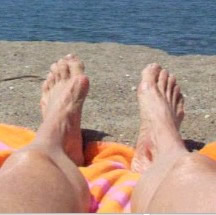
Photo of feet on beach blanket, ocean in frontYou should be relaxed and resting on your laurels after a long day on skates, especially if you managed to avoid getting blistered or bruised feet (see my review of eZeefit ankle booties for those complaints). But for some, tired or crampy feet or lower legs can be painful or distracting enough to ruin that well-deserved lounge time.

Listed in short- to long-term order, here are some tips to treat the most common foot-related after-affects of a long roll, and perhaps even head them off in the future.

Dehydration – Drink plenty of water daily, sip often during your long roll, and chug extra fluids the remainder of the day. Consider using a sports drink during the activity to preserve or replace essential minerals lost through sweat.

Aching fatigue – Immediately after removing your skates, use 10-15 minutes of stretching to squeeze lactic acid out of hard-worked tissues. This helps head off some of the other symptoms and also restores elasticity lost during the repetitive motions and postures of skating.

Tight foot muscles – Keep a tennis ball in your skate bag. As soon as you finish stretching, stand up and wedge it under one foot. Bear weight to a tolerable pressure to press under your toes, then the ball, arch, and heel. After several seconds, your foot will begin to relax and spread out over the ball. You’ll feel the proof if you stand on both feet before stretching your second foot over the ball.

Lactic acid buildup – Lucky are those who have access to the magic hands of a massage therapist! Lacking that, plan on doing your own foot and lower leg massage. Use massage oil if you prefer, or slippery soap while soaking in a hot bath. You can also use the strong jet of a Jacuzzi if that’s available.

Calf and foot cramping – Regardless of how much you drink, do you still experience Charlie Horses or twitchy calves after a long skate? Boy, I sure do! After years of suffering and trying the above tricks, I learned that when Quinine supplements were used to treat malaria in workers building the Panama Canal, those getting quinine also quit having leg cramps. Eureka! Besides the Tea and Tonic recipe I use, other cramp-reduction remedies include taking iron, potassium, calcium, and/or magnesium supplements and, for those who can stomach it, drinking flat Coca Cola during the activity.

Tight ankles – You may not even know you have them! High-cuff inline skates restrict your range of motion at the ankle. The chance of leg cramps is high after exertion. In off-skates time, you can counteract ankle tightness by using “floppy foot” exercises to retrain your ankles. The easiest way is to sit on edge of a chair or your bed with one leg crossed at the knee. Kick the dangling foot up and down and let it flop loosely in whatever direction you shake it. (It’s OK to use your hands). To add resistance, sit on the side of a swimming pool and kick the water until you can feel successful flopping. The goal is to train your legs’ neuromuscular patters so that the slightest kick from the knee will cause a flop.

Muscular imbalance – Skating and many other sports strengthen the back calf muscles more than the front ones. There are not so many ways to gain corresponding strength in the front shin muscles. An easy and enjoyable way to build shin strength is to walk down a steep hill twice a week; of course you must also walk up.

Quench your thirst and treat your feet: That’s how to take care of tuckered tootsies after they’ve had a long, hard day.

Tea and Tonic Iced Tea

Here’s my favorite (zero-calorie!) beverage. Makes 2 servings

Let steep for 45 minutes to an hour:
– 12 oz. of plain, cold water
– 2 fruity (non caffeinated) tea bags of your choice

To serve, combine:
– 6 oz cold tea
– 6 oz Diet Tonic water (I prefer the flavor of Schweppes) *
– Garnish with lemon (optional)
– Ice cubes (optional)

* Diet Tonic water is sweetened with Saccharin, which despite bad press during the launch of Aspartame, has never been scientifically proven to cause cancer in lab rats. Further research revealed that Aspartame is considered the most dangerous of artificial sweeteners! That’s why Stevia is a mainstay at our house.

August 12, 2012

Get Rolling is on Facebook

Filed under: Sk8 Links,Skating — Liz Miller @ 3:06 pm

After years of building pages, maintaining indexes and style sheets, coddling content and FAQs and learning web development skills with Dreamweaver, I had to admit that my old-school web site www.GetRolling.com was no longer cool enough in today’s fast-paced, dynamic world!

Moving my Orbit newsletter to this WordPress blog in 2010 was the first step to making my interactions with skaters around the world more immediate and intimate.

Now I’ve opened up an even more dynamic presence. I hope you Like my new Facebook page, Get Rolling with Liz Miller. All from one place, in Facebook you will be able to read the Orbit Blog and my Twitter stream (@Sk8teacher) along with the photos, links and status updates I am using to keep things lively.

The Get Rolling timeline shows the birth and evolution of my books and other milestones. Besides items from the Internet, I am also pulling the best tidbits from the old website into my Facebook page. My mission is still the same: to share the joys and benefits of inline skating with others through my writing.

Drop by for a visit soon! And be sure to click Like to if you want to keep up with Get Rolling on your own Facebook stream.

« Newer Posts — Older Posts »

Powered by WordPress