the Get Rolling Orbit Biking ~ Fitness ~ Adventures ~ Inline Skating

November 16, 2010

My Head is Spinning!

Filed under: Fitness,Liz's Journal — Liz Miller @ 8:09 pm

I joined my first-ever Spin class today. I knew what I was getting into because I’d received good advice from the girls at the gym and by researching it on the Internet. But still!

My tendency is to avoid bicycles and let Dan be the hardcore biker of the family. But although I have resisted group classes for years, I decided a morning Spin class was worth doing because it’s a great fall activity to get in shape for ski season and I have not been keeping up on my interval training. I also like the fact that it is possible to work very hard doing this (read: burn more calories!) and make great improvements in both muscular and cardiovascular endurance. I have to say, though, that if this class wasn’t convenient and free, I never would have considered joining, despite the fact my fellow gym mates were always convinced I’d love it and wondered why I’ve held out for so long.

Here are my impressions from today’s Spin experiment:

  • My rear was so happy I had a gel seat cover! The water bottle was great to have too.
  • How in heck am I supposed to hear the instructor when the music is blaring so loud? I had to watch her and the others for cues. Loud noise has always made me uncomfortable.
  • The lights were so dim I couldn’t read my heart rate monitor without twisting my arm toward the window on the opposite wall.
  • Funny, nobody else seemed to be using a HR monitor. Maybe the bike’s tension dial gives them enough feedback about how hard they’re working.
  • My legs started burning right off the bat, even though I tried to keep the tension low.
  • I never did feel breathless (maybe I just couldn’t tell with all the noise!)
  • My heart rate shot up to the 160s within 10 minutes and it never looked back. I reached the 170s during the hill intervals, but never felt I was reaching a recovery rate during the “rest” periods. Should I be worried? My dad just had a stroke…
  • The toe basket was too long to secure the balls of my feet over the pedals for proper pushing.
  • Since I didn’t have clip-in shoes, I was not able to pull the pedals up while going hard.
  • The ability to pull up seems to be key to reaching the faster RPMs.
  • A lot of my classmates looked like they were going all-out on the “climbs,” apparently fully adapted to this workout.  That’s my goal.
  • I did not drip all over the bike, but I could not stop sweating after my cold shower (and before my first-day-at-work meeting!)
  • I felt really awkward every time we stood up on the pedals. I learned to increase the resistance so I could maintain a rhythmic stroke.
  • Because I’d worked so hard this morning, I treated myself to some leftover Halloween chocolate this afternoon!

I know that bending forward tends to make my heart rate readings higher than being upright but I was still shocked that it stayed so high for so long. As I continue participating in these classes, I figure my lower body will begin to adapt to the stress so that my heart won’t have to pump so hard to keep the legs going around and around and around.

Wonder where I can find a sale on bike shoes with clips?

November 9, 2010

Rolling into the Off-Season

Filed under: Skating — Liz Miller @ 1:09 pm
Red roses against yellow leaves
Summer to autumn to winter

As the harvest hues of autumn overtake the jewel tones of summer, another busy holiday period approaches. For many, thoughts turn from outdoors pursuits to arranging cozy family get- togethers and bracing for cold days and dark nights, knowing that outside the monochromes of winter will reign for months to come.

This turning of the seasons not only signals the end of fun in the sun for most skaters, it also significantly hampers their skating-related workouts and favorite form of socializing. But to me, the colder the weather and the more it rains, the more excited I get.

Few of my roller buddies know my original inspiration for buying inlines back in 1992 was a magazine article that suggested skating on hills was a great way to cross train for alpine skiing. It took a couple of years to learn how to make inline ski turns, but every moment I spent in that pursuit contributed to the solid foundation that serves me so well in both sports today. I must confess that my love for skating is not quite as strong as my passion for spending hours with Dan on the ski slopes every winter.

Skater on autumn street
Ski poles, dry pavement and gravity!

In the fall, I like to grab my rubber-tipped trekking poles and skate from home to my favorite neighborhood street. It has sweet, smooth pavement and just the right pitch — not too steep that I get going too fast, and not so tame that I have to stride for speed.

The delicious feeling of carving asphalt turns is so similar to the motions of skiing that every skate run I make in autumn hones my technique, balance, and confidence for dealing with the wide variety of snow conditions we’ll find as winter evolves. I feel the results of my efforts in my very bones the first ski day each year. Better yet, the vigorous stride and pole work on my climb back uphill delivers an added training benefit because I usually approach my anaerobic threshold as I get to the top. This is my favorite form of interval training, and I know it will keep me going stronger and longer at 8,000 feet altitude as I hit my favorite mogul fields and black diamond runs a few weeks from now.

One of the best parts about living in California is that we can skate year round, even during winter. Once we’ve had a couple of dry days, we simply dress in layers, gear up, and head outdoors. I really wish everybody who loves to skate and ski as much as I do could have a California Dreamin’ kind of fall. Since that’s not possible, I promise I will enjoy this one for you while I wait for the inches of precious white stuff to accumulate and my favorite ski lifts to start turning.

And I’ll try not to resent the first blush of pink blossoms when they appear on the bone-bare tree branches next spring.

November 7, 2010

Inca Cities: Machu Picchu and Cusco

This is the third of three posts describing a trip for which I was the US representative from Zephyr Adventures, which runs their Royal Inca Trail Trekking adventure with local experts from Apumayo.

Machu Picchu

Machu Picchu

(See related password free photo albums on Picasa.)

The overnight downpour had me worried, but fortunately, we awoke to high clouds for our Machu Picchu visit. We beat the crowd by leaving on the 6am bus, and as we paused to explore all the important places in the ruins, Santiago did a wonderful job of educating us about its significance, both historically and astrologically.
Santiago knew that the 400 reservations to climb Wayna Picchu were sold out, but Pam was eager to go with me, so he approached the entrance gate and said we’d  lost our tickets. The guy believed him, of course (two middle aged blond women!). To our gratification, the stone path was not slippery and there was no crowd.

Liz and Pam on top of Wayna Picchu
Sitting atop Wayna Picchu was Pam’s favorite moment

We made our way up the steep and narrow trail in an hour, climbed through the two rock tunnels, and got to the huge boulders at the very top. A couple with a small baby shared the moment, taking photos with the ruins in the background. Then the mom started nursing! We decided to descend on the same route we came up to avoid the steps with a steep drop-off next to the stone buildings, which I remember quite well from 2008. On our way down, I snapped a photo of a guy who was hiking barefoot and not carrying shoes!

After a delicious buffet lunch back in town, our group boarded the Vistadome car on PeruRail for a ride back to Ollantaytambo. We were treated to snacks and an alpaca wool fashion show. Since I’d seen this in 2008, I worked on my journal most of the ride. I swear the female model poked me in the shoulder as she passed to punish me for ignoring her!

Cusco

Waiting with the van to pick us up at the Ollantaytambo station, our solicitous and competent driver Antonio had us back in Cuzco by 5:30. The Picoaga hotel is fantastic, a converted colonial building. Tonight’s dinner on the Plaza de Armas was delicious! As a wrap-up, I presented our group’s tips to Santiago and  Zephyr Adventures awards to our newbies: El Condor for Randy (a pilot, and due to arthritic hips, better at flying), Poderosa for mighty Marie (that’s what she named her sapling in Cachiccata), and Queen of the Apu for Heather who summitted her fear of heights.

We were moving slowly this day, and some of us felt a little ill on the final morning, which Santiago says is typical. After a half night’s sleep and gastric distress, I could barely manage a balance bar for breakfast. Pam and Heather both have sore throats.  Looking dapper in a necktie, Antonio loaded big suitcases into the van and by 9:15 we were on our way to the local market frequented by Santiago and his family. What a variety of smells and scenes! From butcher counters to eateries to stalls crammed with grains, jewelry or spuds, to farm ladies seated on the concrete surrounded by their vegetables.

Saqsaywaman ruins above Cusco

Santiago had Antonio drive us up to the  Inca temples and fortress overlooking Cusco. At the water temple we saw the beginning of the northern Inca trail leading to Machu Picchu which ultimately leads to our trail. We moved on to a rocky temple with two sacrificial alters carved into into a cave. Then Randy, Olive and I crawled through a rock tunnel to reach a large terraced amphitheater and on to Saksaywamen, with its zigzag walls of the most massive boulders.

Before descending back to the city, we stopped at the baby alpaca store and I was able to pick up super soft sweaters for Dan and me.  We stopped for lunch at Fallen Angel, where a gay decorator obviously satisfied every wild whim he’d ever had. Our lunches were served on an old bathtub fish tank covered with glass.  Santiago enjoyed sharing Cusco’s modern side with us, after so much history.

Before we knew it, we were giving good-bye hugs at the airport, sending our trekkers home with their memories, photos and souvenirs. This moment of separation with newfound friends is always sad.

Santiago and I took a taxi to the Apumayo office, where  I met Kati and owner Pepe. They mapped out the logistics for our 3-day sample trek of the Inca trails closer to Cusco.   The rest of my day was spent napping, organizing my duffle and luggage, and emailing Zephyr a detailed trip report.

First post:

November 6, 2010

The Royal Inca Trail to Machu Picchu

This is the second of three posts describing a trip for which I was the US representative from Zephyr Adventures, which runs their Royal Inca Trail Trekking adventure with local experts from Apumayo.

Trekking Day 1

(See related password free photo albums on Picasa.)
Cactus blooms in the Peruvian highlands

Though I saw this section in 2008, hiking the first leg of the Classic Inca trail was even more impressive with sunshine to highlight the views of the ruins, the Urubamba River valley, the mountains, and up close, the blossoms of a Peruvian highland springtime.

We branched right to exit the “Classic” route and began our descent to the ruins of Llaqtapata after which we joined the Royal Inca trail heading north alongside the river. I was impressed by the beauty and easy walking along the terraced, eucalyptus-shaded trail we passed just before stopping for lunch where the terraces ended.

Hiking on an Inca terrace
Terrace hiking on the Royal Inca Trail

After eating, we trekked through dense cloud forest and snapped photos of purple orchids. Our group was plenty challenged by today’s climbs and descents; at Santiago’s advice, sidestepping was used to save aching knees and hips. The afternoon clouds gathered and we pulled on jackets and ponchos to hike in the rain that started as we neared the campsite, where tents were already set up and waiting for us. We tucked inside to dry out and get organized. Soon after, we were gratified by basins of hot wash water at the tent door and a call to tea, where we were served biscuits and hot drinks.

Trekking Day 2

After a rainy night, we were relieved to awake to a warm sun. The highest peaks above showed freshly whitewashed glaciers. We hung damp items to dry while we feasted on bread, pancakes and liquid yogurt over puffed wheat.

Glaciers above the Urubamba River canyon
Glaciers above the Royal Inca Trail

Our morning hike along the river’s edge took us up and down mossy Inca stairs, through dense jungle, across avalanche slopes and past more delicate purple and white orchids. The group kept its usual start and stop pace and I switched between chatting, trail maintenance and taking way too many pictures. The most alarming stretch of today’s trail was a large slide that denuded the hillside from 100 yards above the riverbed, and it stretched 100 yards of gravelly trail across. It was pretty hot by the time we got to camp at the Chachabamba ruins, where we were treated to a hot lunch (!).

After we ate, Santiago walked Randy and Marie Barber across the bridge to catch the next train to Machu Picchu Pueblo (aka Aguas Calientes). Due to a history of sports that has Randy facing his second hip replacement surgery next year, and an overuse knee pain that crept up on Marie yesterday, this plan allowed them to avoid tomorrow’s steep climb and long mileages. We’ll meet them at our Inti Hotel tomorrow evening.

The waterfall below Choquesuysuy ruins
Approaching Choquesuysuy ruins

While everybody else puttered around camp, Santiago, Evan and I hiked further up the river to see the Chokasuysuy waterfall and ruins. This section of trail was a barely trodden path through the forests above the Urubamba and we found out later it is still closed for repairs. One washed out section offered just a single, tilted, gravelly step high above the roaring brown river, with no mistakes allowed! The ruin itself offered great views of Winyawayna high above, which is tomorrow’s destination. There were lots of living structures both above and below the many rows of farming terraces. The mosquitoes were biting furiously, so we didn’t stay long.

On the way back to camp, I stopped at the sweet little Chachabamba ruin nearby and had it all to myself for a session of sunset photography. At camp I managed to get a cold shower in the dark just before dinner.
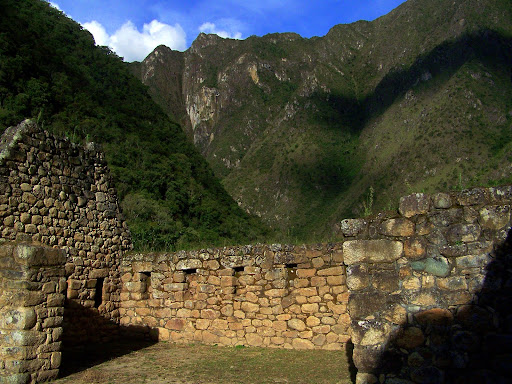
Chachabamba ruins
Chachabamba ruins

Trekking Day 3

Despite more nighttime rain, the grass outside our tents was dry by 5am. Before hitting the long uphill trail, we presented our cooks and porters with a generous thank you tip and various camping articles we could do without. As we marched past the Chachabamba ruins and turned toward Winyawayna, we were grateful for the cloud cover, because the sun would otherwise be at our backs all during the 3-4 hour 1000 foot climb.

We made a steadily ascending traverse across a recovering burn site where young trees have been planted to secure the earth from erosion and the increased threat of landslides. We have heard from Santiago that the first three months of 2010 were so wet that flooding and 17 separate slides closed the railroad for months. Our Royal Inca trail, which is normally open year round, was only just reopened three weeks ago, just in time for us!
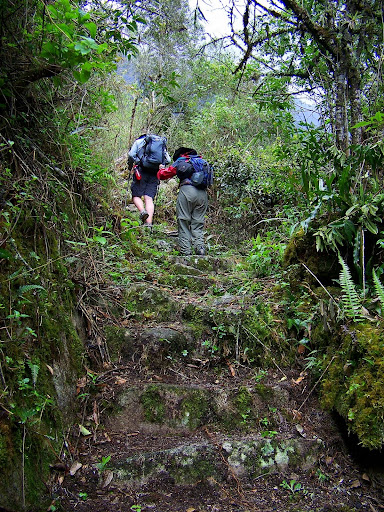
Inca stairways, still intact after hundreds of years

Today we climbed up and down many Inca-built stairways, some with the more modern convenience of hand rails when the drop-off was particularly dire. We paused for a brief but welcome R&R at both of the thatched-roof overlook huts spaced one hour apart, snacking on oranges, biscuits and hard candies provided by our cooks.

Trekking poles helped a lot and by 11am we reached the waterfall and lower entrance to the gorgeous “Forever Young” (Winyawayna) ruins, one of Santiago’s favorites. It features a stair-stepped water purification system, a hilltop sun temple and stone dwellings for the farmers who tended the terraced fields to grow food for the Inca, their living God. After the obligatory group photo here, we made the final climb to a nearby campsite and its obnoxious restaurant. While the clean bathrooms were welcome, the blaring music and commercial operations gave me culture shock after our days in the wilderness. (I later learned that the restaurant concession has been revoked and this campsite will be closed next year.)

Hikers pass over a retaining wall supporting the Inca Trail
Approaching the Sun Gate

Resuming the hike after consuming our picnic of sandwiches, we completed an hour-long traverse to the Sun Gate, marked by a final laborious climb up 50 infamously steep Inca steps. We savored our first views of the city of Machu Picchu across the valley, especially Heather, who had conquered her fear of heights to get here.

The last hiking leg felt long because now our feet were throbbing. We paused for classic Machu Picchu photos just above the tourist entrance and then caught the bus down to Aguas Calientes. The seven of us rode in the back row of the bus down 16 narrow, gravel hairpin turns — don’t look down! From back there, it was extra exciting each time we met an uphill bus.

I don’t mind admitting I was feeling beat by the time we met Marie and Randy and checked in to our hotel at Machu Picchu Pueblo. But a cold Cuzquena delivered by Heather and a change out of hiking boots revived me enough to go out in search of camera batteries.

Even though dinner was “on our own” this night, we agreed it would be more fun to dine together at one of Santiago’s favorite spots. Randy and Marie regaled us with stories of their upscale day of rest in another hotel. As I’d promised earlier in the trip, I did indeed eat guinea pig (cuy), and we washed down our meal with a terrible Peruvian cab. At least my cuy dish was moist and tender; it is a rich dark meat that reminded me of duck. My plate was garnished with a 5″ tuber carved in the shape of an Incan warrior.

Too tired to write a journal with my thumbs on the Droid, I didn’t need to read my Kindle to wind down for sleep. With hand-washed clothes draped around the room for drying and an alarm set for 5:30 am, I switched off the light. Zzzzzzzzzzzzzzz.

Next post:

November 5, 2010

Peru – Training for Trekking

Filed under: Adventures,Liz's Journal — Tags: , , , , — Liz Miller @ 12:00 pm
This is the first of three posts describing a trip for which I was the US representative from Zephyr Adventures, which runs their Royal Inca Trail Trekking adventure with local experts from Apumayo.

On my own

To help make sure each person who signed up for this trip has an outstanding Zephyr Adventure,  I have studied maps, a calendar, and Zephyr printouts during the three flights it took to get here from SFO.  I also added a little trekking checklist to each gift packet assembled today. My first morning in Lima, the steaming hot milk and strong coffee made a great breakfast along with scrambled eggs and a croissant. How to drink coffee in Peru: first pour a tablespoon or less of steaming hot milk into the cup, then add thick black coffee (and water if necessary) to just the right color of tan. With an afternoon of free time, I explored Lima’s famous Kennedy Park, did some shopping, and had a very tasty ceviche lunch before returning to the hotel to meet my fellow trekkers.

Grouping up

Dining in Lima
Dinner in Lima with native Teo Capcha

Meeting up at Casa Andina we all agreed it would be fun to share dinner. Pam from Florida was my roommate,  I’d bumped into our three Canadians in the hall — Randy, Olive and Heather — and then I called Californians Randy and Marie in their room. Meanwhile, I’d also left a note on Teo Capcha’s Facebook wall, and was delighted when the Lima native I’d gotten to know at my favorite ski area in Tahoe telephoned not long after. He fit right in with this friendly group, from our first toast with Pisco Sours to the last. What a great start for our Peruvian vacation!

Touring the Sacred Valley

(See related password free photo albums on Picasa.)

Santiago, the guide I knew when I was a customer in 2008, was waiting at the gate in Cusco. As he and our driver Antonio  loaded our luggage atop the van, a costumed Peruvian lady made a few sales of coca candy and knit hats and gloves. We drove into the center of town, past the Plaza de Armas and up several narrow blocks to Plaza San Blas where we stopped for lunch at PachaPapas. We dined on traditional dishes in a tiny courtyard while a man played a harp next to the the wood burning oven.

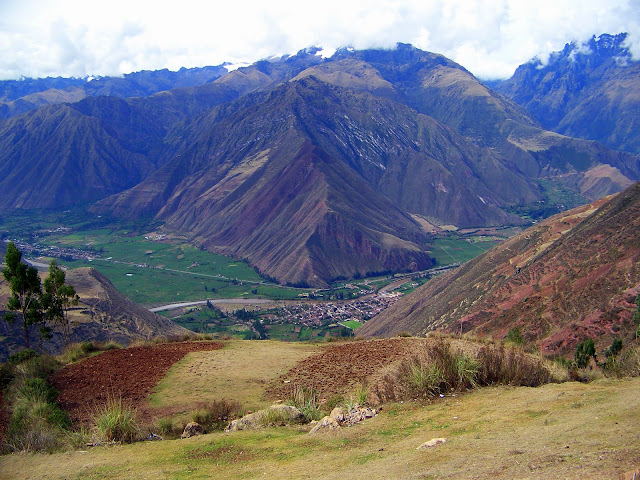
Urubamba, in the Sacred Valley

Urubamba, in the Sacred Valley

Driving from Cusco to the Sacred Valley, we stopped to snap photos of it from the altoplano above. The Casa Andina here has a spectacular glass-walled main area offering natural lighting and views of the grounds and mountain backdrops all around. Tethered llamas trim the grass, and four costumed ladies plant themselves and their wares in an unavoidable section of walkway to our rooms. During our dinner the electricity went out but the lit candles saved the day to beautiful effect. Our one-man pan pipe band played on.

On Tuesday we tried not to stuff ourselves at the buffet breakfast. I was glad to hear that all the high altitude headaches are gone. We drove back up to 11000 feet and toured the Moray ruins, where the “flying steps” presented a challenge for some, and the hike back uphill taxed our breathing. As we hiked towards the village of Maras, we enjoyed vast views of tilled fields and distant snowy peaks frosted by clouds. The sun was quite warm when it came out. Hernando had a tasty picnic waiting for us in a tent set up in Maras, with pretty woven tablecloths. He wore a chef’s hat and tunic, so cute!

Bags of harvested salt lined up next to the salt pools in Maras
Salt for Lima, harvested from the same pools used by the Incas

To avoid two hours of optional hiking, we hitched a van ride to the salt pools, and all but two of our group hiked down the salt-encrusted trail alongside the pools. The light was so incredible for photos! Heather has a fear of heights so she shadowed Santiago in the narrowest spots.  Our incredibly delicious and elegant dinner was in the village of Urubamba, which is still digging out the mud after a chunk of glacier broke off above town, flooding its narrow streets with the snow melt.

Ollantaytambo and Cachiccata

Skulls in a nitch in an Ollantaytambo home
Honoring the ancestors in a kitchen nitch

Cottony clouds and a deep blue sky brought a morning glowing with the promise of good weather. We loaded up the van and made a stop in Ollantaytambo square. We strolled up a narrow cobbled street  to the neighborhood where modern-day Peruvians occupy homes built upon the foundations left by the Incas. No mud here because of the Incas’ beautifully laid mid-street drainage canals. We toured a villager’s home and several of us purchased souvenirs, taking care not to step on the small herd of cuy (guinea pigs). They are called cuy because of the “cuy, cuy, cuy” sounds they make.

Ollantaytambo ruins
Ollantaytambo ruins

Sun graced our tour of the Ollantaytambo ruins, which made for great photos. After that, we visited the porter village of Cachicatta, which overlooks the emerald hued north end of the Sacred Valley bread basket. It took longer than expected to heat the rocks for our pit-roasted potatoes, lamb and chicken, so we went down the road to the restoration project that Apumayo sponsors and planted a sapling in the nursery to be moved to an erosion-prone hillside after it grows tall and strong. We were glad to pay a $10 donation to the village to get an “adoption” certificate with our tree’s name. As we shared our lunch table and roasted victuals with our staff of porters and a few of their family members, Santiago had everybody introduce themselves with name, age, marital status and number of kids or siblings. The Peruvians were surprisingly not shy, especially the mammacita who was nursing her child at the lunch table as she took her turn to speak.

It was finally time to hike to our first trekking campsite!  Starting from Cachiccata, we descended into the Sacred Valley until we were on the western shore of the Urubamba River. Piskacucho at km 82 on the railroad line to Machu Picchu is a very nice campsite, featuring showers and bathrooms with sinks and toilets with seats (which is not always the case).  Our simple meal of soup, trout with a sauce, and choice of rice or mashed potatoes was completed by a dessert of sweet red corn pudding. Just before we climbed into our tents, the clouds cleared and snow-capped mountains glowed under a near full moon. Gorgeous!

Amazingly, I slept an uninterrupted 8 hours on my wonderful air mattress, a full length Thermarest. What I thought was the 11 pm train whistle turned out to be the 5 am. Clear skies today! Now I have a gorgeous view of snowy Mt. Veronica and my coca tea is steeping.

Mt. Veronica's snowey peak
Click this image to see all of my Peru 2010 photo albums

Next Post:

October 30, 2010

Protected: Inca Trail Scouting trip

Filed under: Adventures,Liz's Journal — Liz Miller @ 1:18 pm

This content is password-protected. To view it, please enter the password below.

October 3, 2010

Possessed by Peru

Filed under: Adventures,Liz's Journal — Liz Miller @ 11:51 am

I am currently hiking several miles of hillside trails every week to prepare for my role as guide for Zephyr Adventures’ Royal Inca Trail trek to Machu Picchu, starting on October 17. The dust dims the sheen of my new backpacking boots, my packing list gets longer, and I read (tragic)  stories from the 1500s about the conquest of Peru. I go to the gym, I dive into my full-time day job and I give the occasional skate lesson, but really, my heart and head are in Peru for a good portion of every day.

All of my discretionary listening time right now is filled with Spanish love songs and verb conjugation audio tracks.  I pore over the guide books and maps I collected for my first trip in 2008. Since I have already hiked the Classic Inca Trail as a customer, I have a journal and my Machu Picchu photo album to help me visualize a lot of what I will encounter on the slightly different routes we will follow this time.

I wish everybody could have such an adventure! Since I realize that’s not possible, I thought it would be nice to share a snippet from my April 21, 2008 journal entry and some of the photos I took the day we explored the Sacred Valley of the Incas. After exploring the local ruins at Ollantaytambo, our next stop was the Moray ruins that served as a unique Incan agricultural laboratory. From there we hiked down to the salt collection pools at Maras.

April 21: This morning we explored the Ollantatambo ruin in town after hearing a fascinating history lesson from Santiago. Then we drove into the western hills at 11000 ft above to view the Inca laboratory ruin, Moray, where each terrace of the circular rings contained different soils and growing temps to experiment with developing high altitude strains of precious coca and other foods.

We hiked a trail through hilly farmland with a variegated green quilt climbing every slope in the background.  Snow capped peaks jutted into the clouds across the Urubamba valley. After an easy stroll, we passed through a little town and then stopped for a picnic of hot soup, chicken and boiled spuds, and a desert pastry presented on a tented overlook by bus driver Freddy.

After lunch we rolled through a hail downpour on the drive to the salt pools created from a mineral stream 700 years ago and still in production. We were grateful the rain had stopped by the time we started the descent along the left side of the 2000 ponds ranging from glistening white to dry terracotta. These are tended by caretaker families, as they have been since salt cultivation began here. Santiago says most of Lima’s salt comes from this operation.

September 1, 2010

My heel brake doesn’t work! Why?

Filed under: Skating — Liz Miller @ 10:40 am
poor braking stance

Typical braking issues

Proper braking stance

Best starting stance

When trying to brake, if you look anything like the photo on the left, then it’s time you learned the proper posture for making your brake do what it was designed to do. Once you nail the right stance, you’ll be rewarded with better braking effectiveness and confidence. And that means a whole new world of skating destinations will open up for you!

On the left, my trusty model Staci Stance would roll right into traffic because she is:

  • Not bending the left knee enough to get a low center of gravity
  • Mistakenly trying to press the brake pad downwards
  • Bending forward at the waist and looking at her feet, which results in…
  • Putting nearly half her body weight in front of the stopper

In the right photo, take note of Staci’s stance as she demonstrates an effective stop. When you practice this in your favorite  car-free parking lot:

  1. Begin the approach from an upright coast with bent knees (Tip: you should be able to hop over a parking space line in this stance).
  2. Shift head, shoulders and hips sideways, so your weight is directly over the non-braking support foot
  3. Look forward, not down, to keep head weight behind the brake and over the support skate
  4. Scissors the brake foot forward by straightening the braking knee; notice the triangle at Staci’s base
  5. Scrub the brake forward and toward center line of travel
  6. Stop where you want: shove the stopper further ahead by bending the left knee more (see video)

Great news! The best posture for braking is the same stance you will use to prevent unwanted speed buildup on a downhill.  But because this requires good one-footed balance in a narrow scissors, it is a skill that demands repeated practice before it begins to feel natural. That’s why you need to make dozens of stops in a car-free parking lot before getting out on the trails and streets. (I tell my students to shoot for at least 100 practice stops on a line.) For more detailed instructions, see the How to Stop section of my Orbit archives.

Once you master the proper braking stance, you will be able to relax and allow the brake to do its job, rather than trying to force it.

August 28, 2010

Meet Staci Stance, Model

Filed under: Skating — Tags: — Liz Miller @ 5:45 pm

After over 15 years of teaching inline skaters, I have honed the instructions in my lessons to a toolkit of the most effective words and demonstrations. But once the lesson is over and my students have gone home, I can’t give feedback and tips about how to get the most from their skate practice sessions. On the trails, I see skaters who have no idea that they could be going a lot faster or farther with just a couple of  minor adjustments to their skating posture.

Plastic artist model demonstrating heel brake stance
Staci Stance demonstrates heel braking

I now have a willing (if improbably proportioned) model to demonstrate the most common ineffective skating postures alongside the desired ones.

In future postings, you will see Staci Stance in the proper skating ready position and braking stances (good and bad). She will also model the scissors, the basic “A-frame” turn, and a variety of striding postures. Her lack of protective gear can be forgiven because she is not wearing wheels on her feet!

It is my hope that these photographs will inspire my readers to evaluate their habitual skating stances and see if there is room for improvement. Of course I will add links to related instruction articles on www.GetRolling.com to guide anybody who is interested to improve.

August 22, 2010

Idaho Silver Country Skate Tour

Imagine five days of great people, great scenery, and the best inline skating trails you could possibly imagine! I was fortunate to be one of three guides for the August 2010 Zephyr Adventures Idaho Skate Tour in northern Idaho’s Silver Country.

image

On Idaho's beautiful Trail of the Couer d'Alenes

image

Bridges span rivers and lakes on this converted rail trail

Last Sunday, twenty eight active folks from across the country and beyond — ranging in age from their 30s to 70s — jumped into two large passenger vans with skate gear in hand. Those who had just flown in found themselves rolling on the tree-lined Fish Lake Trail in eastern Washington state within a few hours of landing. This short 7-mile route with a swimming lake nearby made a perfect first-day trail.

The next day we rolled on the Centennial Trail from Idaho into Washington. On Tuesday, Wednesday and Thursday, we covered the western, central, and eastern sections of the 72-mile Trail of the Couer d’Alenes across Idaho’s northern panhandle.

Because Idaho’s smooth-as-silk trails pass through a car-free landscape of lakes, rivers and pine forests, everybody was pretty much guaranteed to have a spectacular vacation.

I believe they did! But see for yourself in this 13-minute video by Dan Kibler.

Manhole cover declaring Wallace, ID the center of the universe

Nobody can prove Wallace, ID is NOT the center of the universe (click to enlarge)

image

A skeptic checks out the center of the universe

« Newer Posts — Older Posts »

Powered by WordPress